Product Description
Every experienced paving contractor knows the rule: a steel drum roller shapes the mat, but a pneumatic tire roller seals it. The GZD-YL Series — available as the GZD-YL26 (26-ton) and GZD-YL30 (30-ton) — is a heavy-duty multi-tire road roller engineered specifically for the intermediate and finish compaction stages of asphalt paving, where the rubber tire’s flexible kneading action closes surface voids, eliminates micro-cracks, and produces the dense, waterproof surface that steel drums alone cannot achieve.
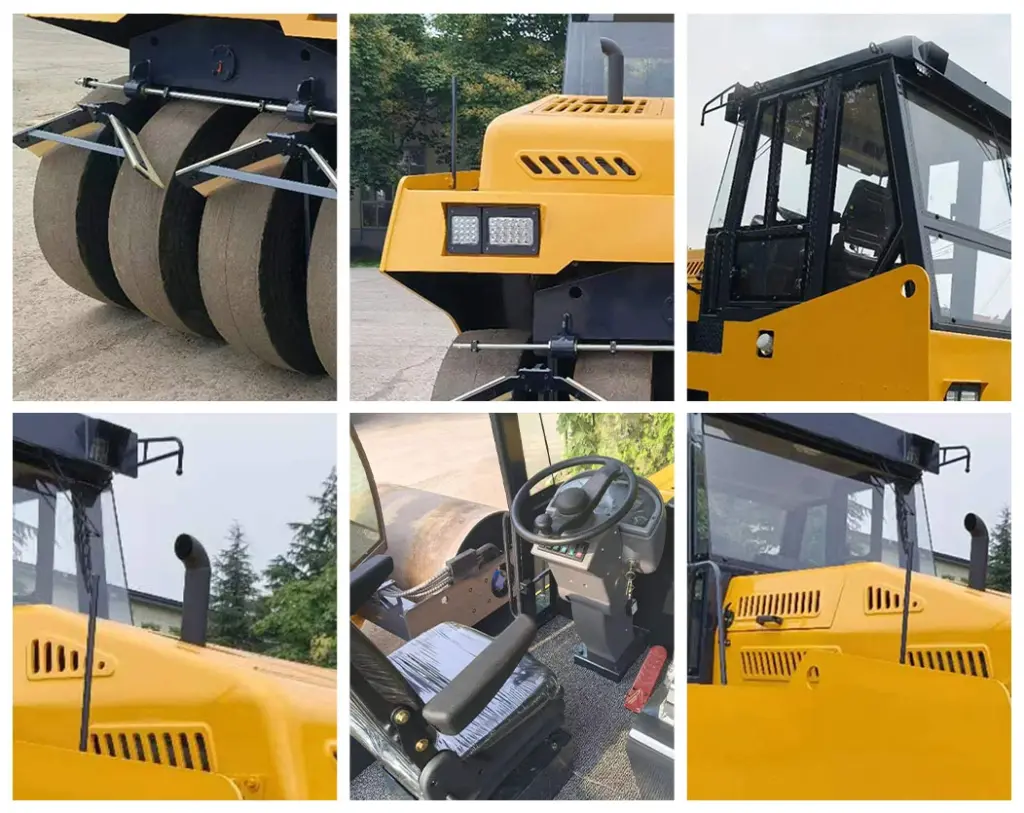
Unlike rigid steel drum rollers that apply concentrated point pressure, the GZD-YL Series distributes compaction force across nine pneumatic tires (4 front / 5 rear) arranged in an overlapping pattern that ensures full-width coverage with zero gaps. Each tire deforms elastically against the hot asphalt mat, generating a “massaging” kneading effect that realigns aggregate particles, expels trapped air, and seals the pavement surface — the precise mechanism behind the 1–3% additional density gain that differentiates a standard road from a premium highway. The result is a pavement with measurably lower permeability, higher resistance to water ingress, and significantly extended service life under heavy traffic loading.
Powered by a Shangchai SC7H-series turbocharged diesel engine delivering 118 kW (GZD-YL26) or 132 kW (GZD-YL30), the machine features full hydraulic drive with two forward speed ranges — a low-speed working mode (0–8 km/h) for controlled compaction passes and a high-speed transfer mode (0–17 km/h) for rapid site repositioning. The centralized tire inflation system, automatic oil-spray anti-stick system, and dual-operator-station design are standard equipment, not options — because on a 12-hour paving shift, these are not luxuries; they are productivity multipliers.
3.1 Kneading Compaction Mechanics — Why Pneumatic Tires Outperform Steel Drums on Surface Quality
The fundamental limitation of steel drum compaction is geometric: a rigid cylinder contacts a flat surface along a narrow line, concentrating pressure into a thin strip that can fracture brittle aggregate particles and leave parallel drum marks requiring additional finish passes to remove. The GZD-YL Series eliminates this problem entirely through rubber tire elastic deformation. Each 13/80-20 diagonal-ply tire — with a 16-ply rating and 600–650 kPa inflation pressure — deforms under load to create an oval contact patch significantly larger than a steel drum’s line contact. This distributes the machine’s 26 or 30 tons of operating weight across a ground pressure range of 200–550 kPa (adjustable via tire inflation and ballast configuration), providing gentle but thorough compaction that:
- Seals surface voids — the kneading action pushes fine aggregate and asphalt binder into surface gaps, reducing air void content by 1.5–2.5 percentage points compared to steel-drum-only compaction.
- Prevents aggregate fracture — elastic tire contact cushions individual stone particles, preserving aggregate gradation rather than crushing it — critical for high-performance SMA (Stone Mastic Asphalt) and OGFC (Open-Graded Friction Course) mixes where stone-on-stone contact defines structural performance.
- Eliminates checking and hairline cracks — steel drum vibratory rollers often induce surface micro-cracking (checking) in stiff asphalt mixes; the pneumatic roller’s non-vibratory static kneading removes these defects during the intermediate rolling stage.
- Enhances interlayer bonding — on multi-lift asphalt construction, the kneading action improves adhesion between successive pavement layers, reducing the risk of delamination under thermal cycling and heavy truck braking forces.
For government highway tenders specifying minimum 96% Marshall density and maximum 4% air void content, the difference between passing and failing QA/QC often comes down to whether a pneumatic tire roller was deployed in the compaction train. The GZD-YL Series makes that compliance margin achievable and repeatable.
3.2 Multi-Tire Configuration with Adjustable Ground Pressure — One Machine, Multiple Materials
Compaction is not one-size-fits-all. A granular subbase layer requires high ground pressure to achieve interlock; a thin asphalt overlay requires low pressure to avoid aggregate crushing; cohesive clay subgrade benefits from moderate pressure with extended dwell time. The GZD-YL Series addresses this variability through three independent adjustment mechanisms working in concert:
Tire Inflation Pressure Control — The standard centralized tire inflation system allows the operator to adjust all nine tires to a uniform pressure between 300–650 kPa from within the cab, without stopping work. Higher inflation pressure increases ground contact pressure for dense-graded base layers; lower pressure increases the tire contact area for surface-sensitive wearing courses. The system maintains pressure even if a tire develops a slow leak, preventing the uneven compaction that ruins pavement smoothness.
Ballast Configuration — Operating weight is adjustable from approximately 14,000 kg (empty) to the maximum rated 26,000 kg or 30,000 kg through a combination of steel plates and water ballast. The segmented counterweight system allows contractors to configure the machine for the specific lift thickness, material type, and specification requirements of each project — essentially gaining the versatility of multiple roller sizes in a single machine.
Tire Overlap Geometry — The 4-front / 5-rear tire arrangement with 65 mm overlap between front and rear tire tracks ensures that every millimeter of the compaction width — 2,360 mm or more depending on model — receives at least one full tire pass per machine pass. The staggered layout (front tires centered over rear tire gaps) eliminates the uncompacted strips that single-axle arrangements leave behind, producing a uniformly dense, streak-free mat across the full lane width.
This configurability means a single GZD-YL pneumatic roller can handle granular subbase, cement-stabilized base, asphalt binder course, and asphalt wearing course — four material types, one machine.
3.3 Automatic Oil Spray & Anti-Stick System — Keeping Tires Clean on Hot Mix
Hot asphalt sticks to cold rubber. It is physics, not opinion — and it is the single most common reason contractors abandon pneumatic rollers mid-shift. The GZD-YL Series solves this with a pneumatically powered automatic oil-spray system that applies a fine, uniform film of release agent to each tire surface before it contacts the hot mat.
The system draws from an onboard oil reservoir and delivers spray through dedicated nozzles aimed at the tire tread face. A two-minute suction refill replenishes the oil tank without the operator climbing onto the machine or handling oil manually — eliminating both the safety hazard of manual application and the downtime of stopping production to re-oil tires. The spray rate is adjustable via the cab control panel, allowing operators to increase oil flow for sticky polymer-modified binders or reduce it for standard penetration-grade asphalt.
Below the tires, a rubber insulation skirt wraps around the tire area, retaining heat to keep the tire surfaces at a temperature that discourages asphalt adhesion. Hot tires do not pick up mix — the skirt engineering is simple but the operational difference is profound, particularly on long continuous paving runs where thermal consistency across the tire set determines whether the roller keeps rolling or gets sidelined with asphalt buildup.
3.4 Dual-Operator Station & Full Hydraulic Control — Comfort That Drives Productivity
Highway paving shifts run 10–14 hours. Operator fatigue directly reduces pass consistency, which directly reduces compaction uniformity. The GZD-YL Series addresses this through a dual-operator-station design rarely found in this price tier: two independent steering wheels, two adjustable suspension seats, and two complete control consoles — one on each side of the machine. This configuration is not about redundancy; it is about visibility.
When compacting the right lane edge, the operator works from the right station, looking directly down at the curb line without twisting or leaning. When the paver moves to the left lane, the operator switches to the left station. The result is zero blind spots on either side, no risk of running over curbs, and no uncompacted strip left along the lane edge — a persistent quality problem with single-station pneumatic rollers.
Full hydraulic power steering with ±35° articulation and a hydraulic caliper disc brake system provide the control precision that multi-tire machines demand. The brake system achieves a stopping distance under 5 meters at full working speed and engages automatically upon engine or transmission failure — a critical safety feature when operating on grades up to 20–30%. The continuously variable hydrostatic drive ensures smooth starts and stops without jerking, preventing the tire scuff marks and mat tears that mechanical clutch engagement can cause on fresh asphalt.
Technical Specifications
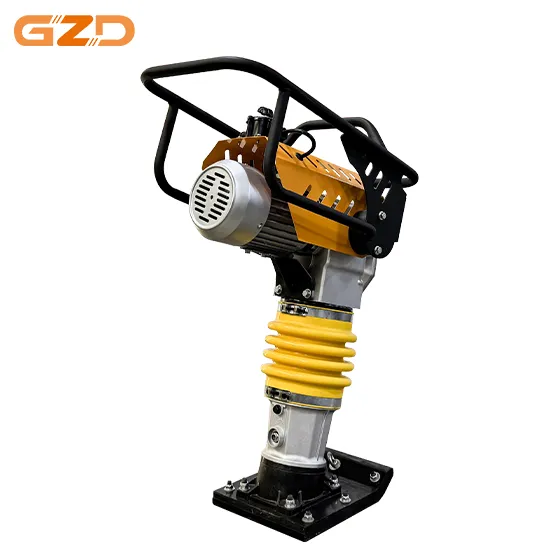
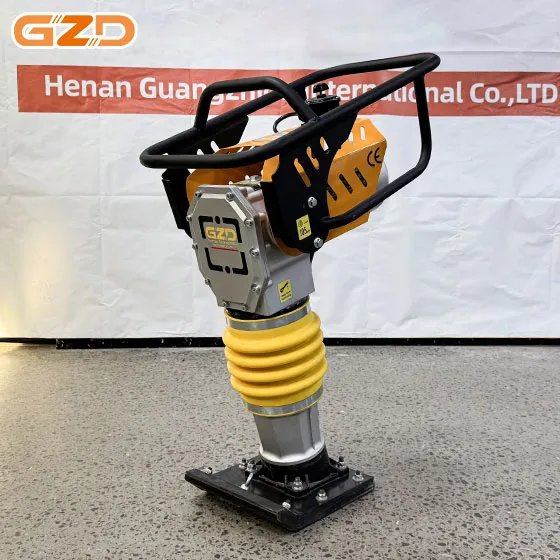
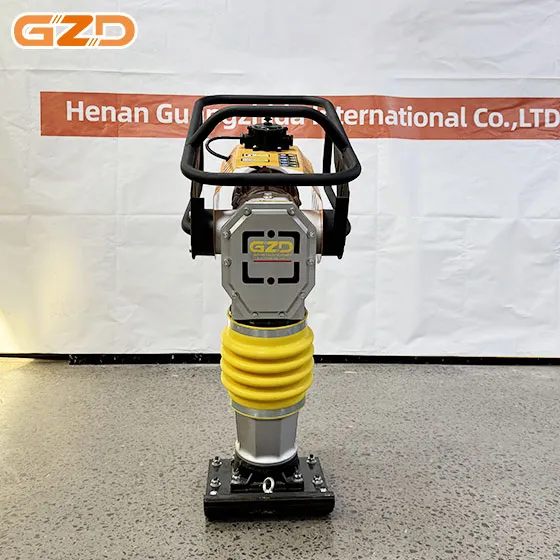
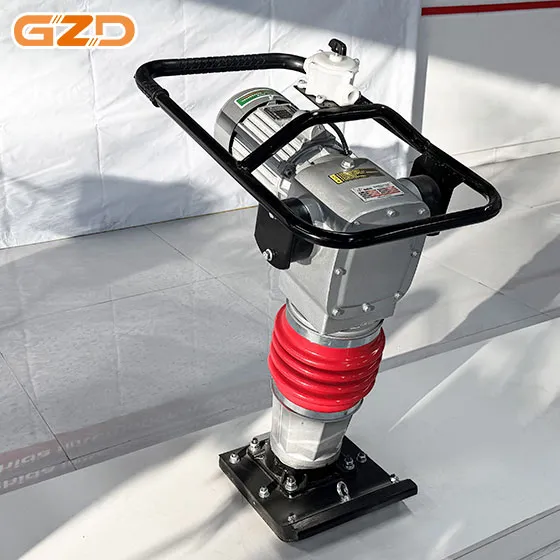
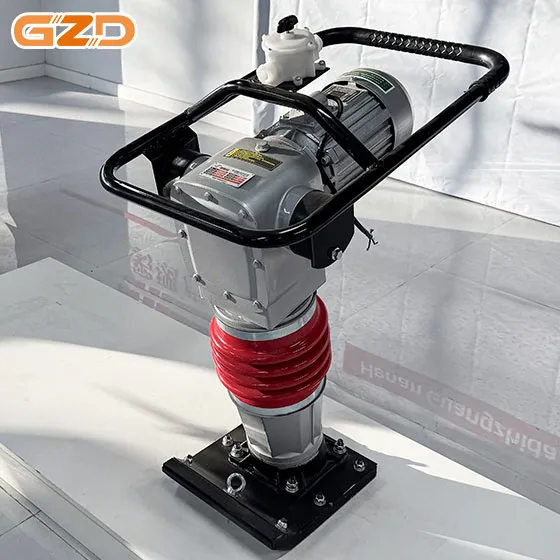
| Parameter | GZD-125 | GZD-110 | GZD-100 |
| Power | 3KW | 3KW | 3KW |
| Voltage | 220V/380V | 220V/380V | 220V/380V |
| Ramming Force | 15KN | 15KN | 15KN |
| Leap Height | 45-70mm | 45-65mm | 45-60mm |
| Ramming Frequency | 640-680 times/min | 640-680 times/min | 640-680 times/min |
| Weight | 65kg | 62kg | 60kg |
| Compaction Depth | 25-30cm | 25-30cm | 25-30cm |
| Standard | JB/T 13972-2020 | JB/T 13972-2020 | JB/T 13972-2020 |
| Origin | China | China | China |
| Brand | GZD | GZD | GZD |
| Stock Status | Ready Stock | Ready Stock | Ready Stock |
Profitable Applications
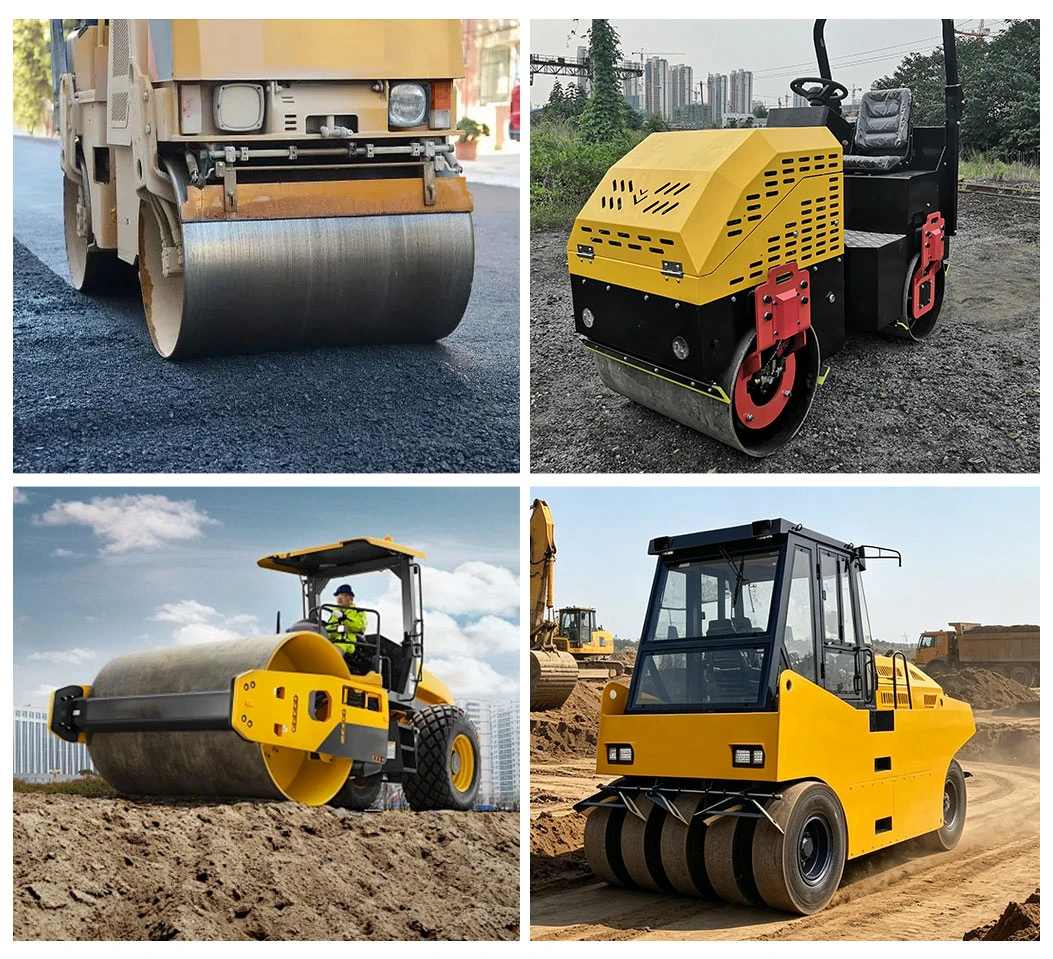
Application Cases
Case 1: Expressway Asphalt Paving — Addis Ababa–Adama Expressway, Ethiopia
Project: 85 km six-lane expressway asphalt surfacing (binder course + wearing course) Contractor: Chinese-Ethiopian JV infrastructure firm Equipment deployed: 2 × GZD-YL30 pneumatic tire rollers (intermediate rolling position) Challenge: Ethiopian Federal Roads Authority specification required minimum 97% Marshall density on the 50 mm BC wearing course, with maximum 3.5% air void content. Initial trials using only double-drum vibratory rollers (breakdown + finish) achieved 95.2–96.1%, failing specification. Solution: Two GZD-YL30 pneumatic rollers were inserted into the compaction train between the breakdown vibratory roller (DYNAPAC CC522) and the finish double-drum roller. The pneumatic rollers operated at 400 kPa ground pressure in the 0–8 km/h working speed range, completing 4–6 passes per station at a rolling temperature of 110–135°C. The kneading action sealed the surface micro-voids that the vibratory drum left open. Result: QA/QC core samples across 340 test points averaged 97.8% Marshall density with 2.9% air void content — exceeding specification. The contractor avoided liquidated damages of approximately $45,000 that would have been triggered by non-compliant density on the initial rolling plan. A third GZD-YL30 was ordered for the subsequent Modjo–Hawassa expressway project.
Case 2: International Airport Runway Resurfacing — Mactan-Cebu International Airport, Philippines
Project: 3,300 m × 45 m primary runway asphalt overlay (60 mm polymer-modified bitumen) Contractor: Filipino-Korean construction consortium Equipment deployed: 1 × GZD-YL26 pneumatic tire roller (intermediate rolling) Challenge: Polymer-modified binder (PMB) asphalt specified for the overlay is significantly more viscous and temperature-sensitive than conventional bitumen. Steel drum rollers caused surface checking (hairline cracks) on trial sections at rolling temperatures above 140°C, while PMB pickup on cold tires forced repeated stops for manual cleaning. Solution: The GZD-YL26’s automatic oil-spray system and rubber insulation skirt kept the nine tires at consistent operating temperature and continuously coated with release agent — eliminating the PMB pickup that had plagued earlier trials. The pneumatic roller was positioned as the sole intermediate roller, with a single finish double-drum roller behind it. Ground pressure was set to 250 kPa (lighter ballast configuration) to prevent aggregate crushing in the thin 60 mm overlay. Result: No surface checking was detected across the full 148,500 m² runway surface. Friction testing (ICAO Annex 14 compliant) confirmed uniform macro-texture across all 12 test sections. The project was completed within the 45-day nighttime-only construction window (23:00–05:00 daily), and the pneumatic roller’s performance was cited in the project close-out report as the key factor in eliminating the surface checking problem.
Case Study 3: Earth-Fill Dam Construction — Thwake Multi-Purpose Dam, Kenya
Project: 80 m high earth-fill embankment dam (clay core + granular shell), eastern Kenya Contractor: International dam construction JV Equipment deployed: 2 × GZD-YL30 pneumatic tire rollers (clay core compaction) Challenge: The dam’s central clay core — sourced from a borrow area with high-plasticity black cotton soil — required compaction to 95% Standard Proctor maximum dry density at moisture contents near the plastic limit. Single-drum vibratory rollers produced a “spring soil” response: vibration energy was absorbed by the near-saturated clay matrix, creating surface heave rather than density increase. Solution: The GZD-YL30 pneumatic rollers replaced the vibratory units on the clay core zone. Ballasted to the full 30,000 kg maximum operating weight, operating at 550 kPa ground pressure, each roller completed 8–10 passes on 250 mm loose lifts. The static kneading action expelled pore water from the clay matrix progressively with each pass, with no spring-soil response observed. The 200L fuel tank capacity supported full-shift operation without refueling on the remote dam site. Result: Field density testing (sand cone method, 1 test per 500 m³) confirmed 96.3% average Standard Proctor density across 480 individual test points over the 18-month core construction period. The zero-vibration approach eliminated the risk of vibration-induced cracking in the adjacent grout curtain and spillway concrete structures — a concern that had been raised in the original method statement review. The contractor retained both GZD-YL30 units for downstream irrigation canal compaction work following dam completion.
Customization


Dealer Customization Policy
FAQ
Absolutely. We offer comprehensive OEM and ODM services for your branding needs, including custom logos, personalized paint colors, and specific packaging designs.
Just 1 unit to start. We encourage sample testing. For bulk orders or mixed-container shipments, we provide aggressive wholesale tier pricing.
We manage the heavy lifting. All equipment is secured in export-grade wooden crates. We offer Sea, Air, and Train freight options, handle all export documentation, and specialize in mixed-container consolidation to minimize your shipping costs.
Yes. Every machine ships with intuitive operation manuals and video tutorials. For major fleet purchases, we provide dedicated remote video training to ensure your team is ready to go.
Downtime kills profits. You have 24/7 access to our technical troubleshooting team. We also maintain a massive inventory of genuine spare parts ready for immediate air freight.
We balance rugged, commercial-grade quality with direct wholesale pricing. We aren’t selling cheap, disposable machines. You are investing in high-ROI equipment backed by a reliable supply chain and flexible payment terms.