Product Description
GZD YHZS Series Mobile Forced-Action Concrete Batching Plant
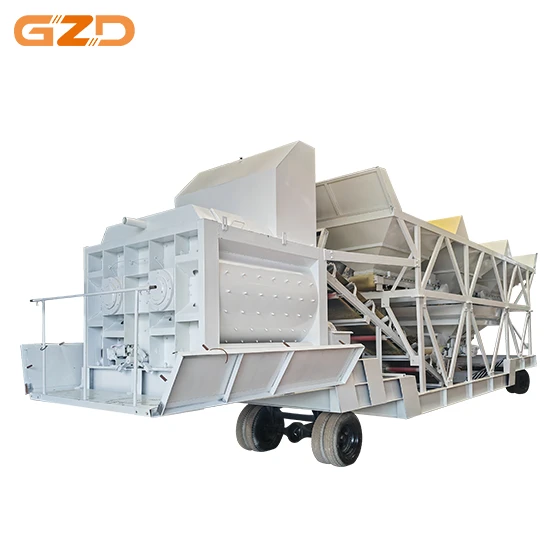
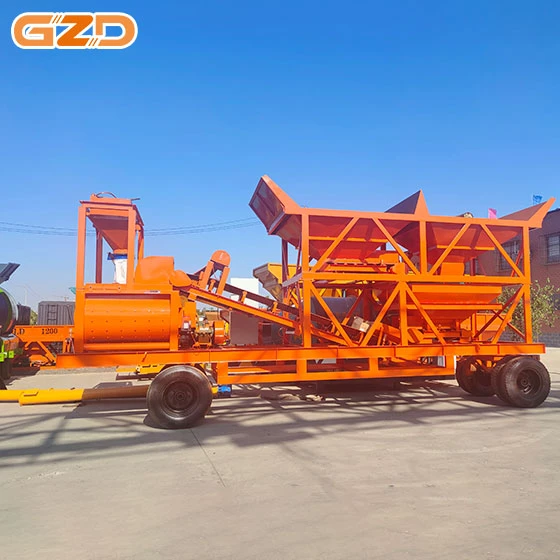
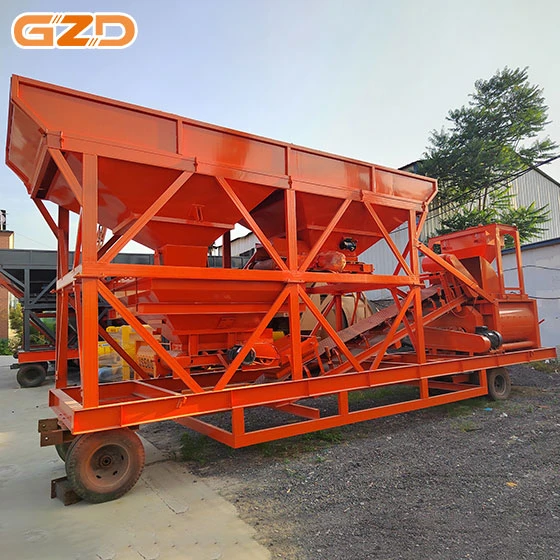
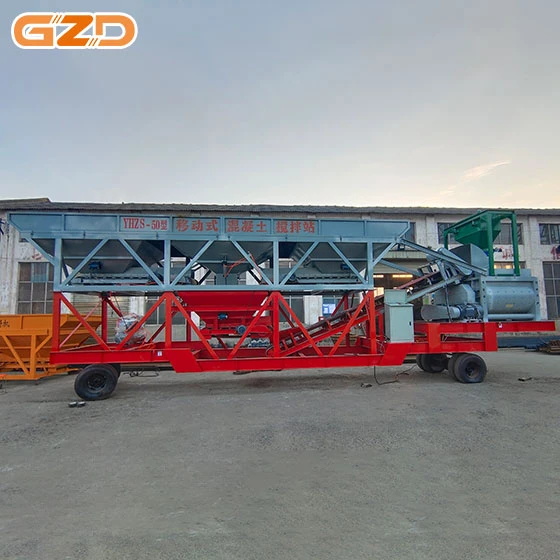
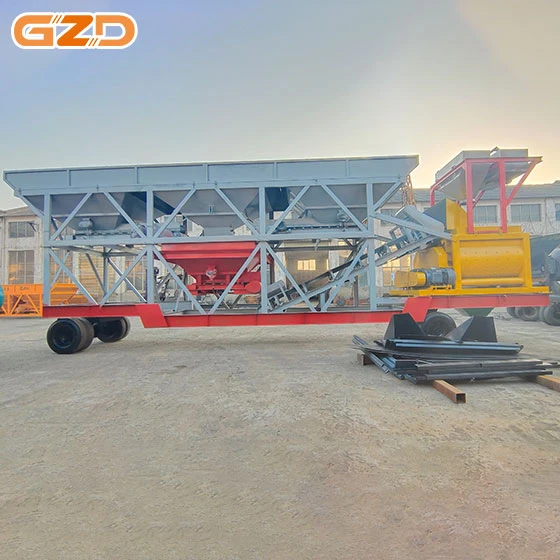
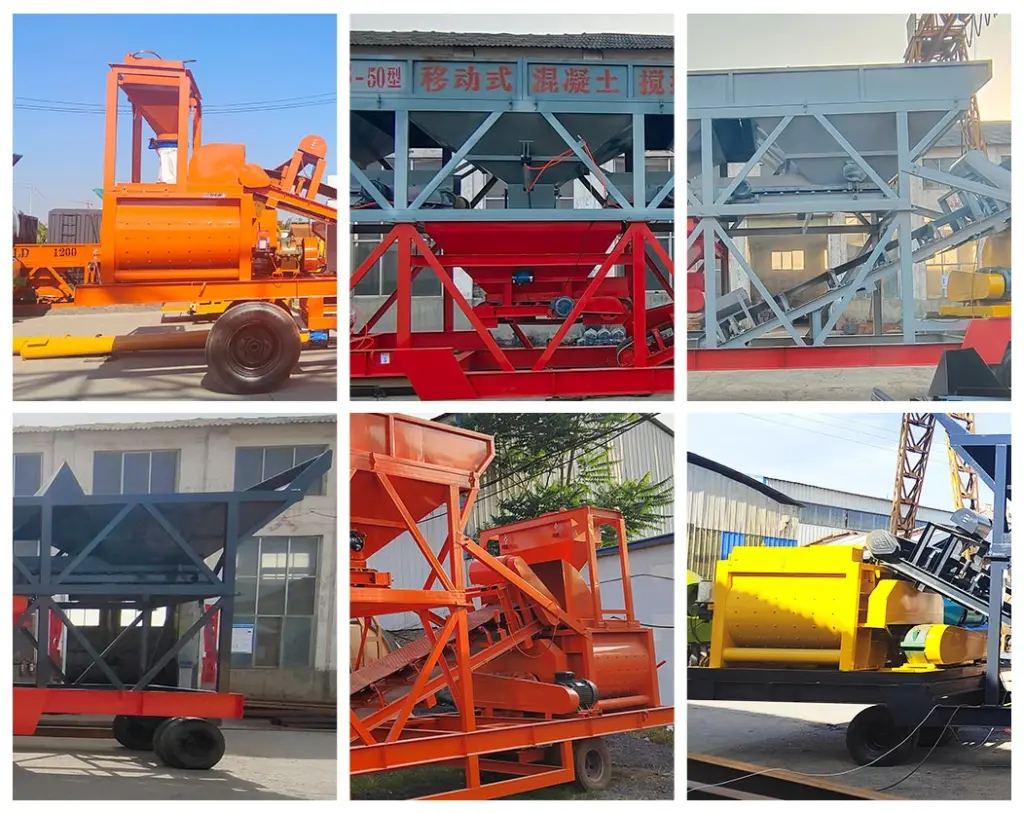
The YHZS mobile concrete batching plant is a trailer-mounted, fully integrated concrete production system that combines aggregate storage, multi-compartment batching, independent weighing, twin-shaft forced mixing, and PLC automation on a single wheeled chassis. Unlike stationary HZS plants that require civil foundations and permanent site commitment, the YHZS series is designed for rapid deployment — arrive on site, level the hydraulic outriggers, connect power, and begin producing specification-grade concrete within 3 hours. With seven models spanning 25 to 120 m³/h theoretical output and JS500 through JS3000 twin-shaft forced mixers, the YHZS series covers the full spectrum from rural road projects to medium-scale commercial concrete supply.
What sets the YHZS apart from its drum-type counterpart (YHZM) is the JS twin-shaft forced-action mixing system. Where a drum mixer relies on gravity and free-fall to blend materials, the twin-shaft design uses two counter-rotating horizontal shafts fitted with arrayed mixing arms and blades that aggressively fold, shear, and circulate the batch. This forced mixing action achieves ≥95% homogeneity in ≤72 seconds — nearly twice the efficiency of drum mixers — and handles dry, semi-dry, and fluid concrete equally well, including high-slump mixes with fly ash, slag powder, or chemical admixtures that tend to stick in free-fall drums.
1 JS Twin-Shaft Forced Mixing System — The Performance Core
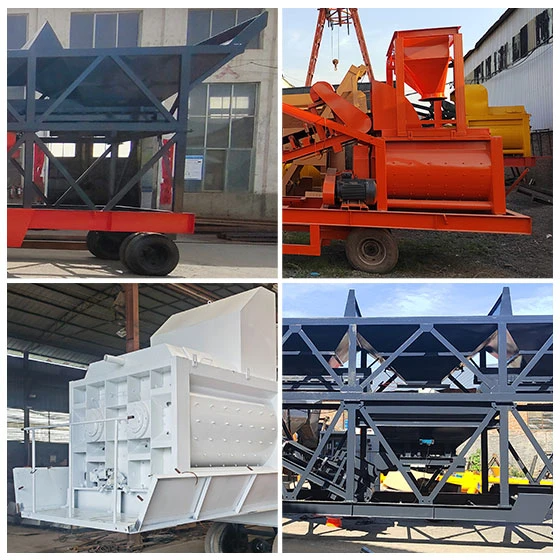
At the heart of every YHZS mobile concrete batching plant sits a JS-series twin-shaft forced-action mixer, the industry standard for specification-grade concrete production worldwide. The mixing chamber features two parallel horizontal shafts rotating in opposite directions at 25–35 rpm, each carrying 7 sets of chromium-alloy mixing arms with bolted replaceable blades (HRC 55–60 surface hardness). The blades are arranged in a staggered spiral pattern that drives material toward the center discharge gate while simultaneously creating a continuous circulating flow — material is lifted, sheared between opposing blade edges, and re-distributed across the full mixing zone every revolution.
This forced circulation ensures that every particle passes through the high-shear mixing zone within the first 20 seconds of the cycle. By the 60-second mark, concrete uniformity exceeds 95% per the GB/T 9142 mixing homogeneity standard — the threshold required for commercial concrete certification. The JS mixer also excels at incorporating difficult materials: fiber-reinforced concrete (steel or polypropylene fibers), self-compacting concrete (SCC) with high powder content, and lightweight aggregate mixes that tend to segregate in free-fall drums.
The mixing arms are cast from high-chromium alloy steel (Cr26) with a minimum service life of 30,000 batches under normal operating conditions. Liner plates on the mixing trough interior are 16–20 mm thick wear-resistant steel (NM400 grade), bolted for individual replacement — no need to remove the entire liner system when one plate wears. The discharge gate is a hydraulically actuated dual-door design that opens across the full trough width, discharging a 1,500-liter batch in ≤8 seconds to minimize truck waiting time.
2 Integrated Trailer-Mounted Chassis — Foundation-Free Deployment
The defining structural feature of the YHZS portable concrete batching plant is its integrated trailer-mounted chassis. All functional modules — aggregate batching bins, belt conveyor, cement weighing hopper, water and admixture tanks, JS twin-shaft mixer, control cabin, and pneumatic system — are permanently mounted on a single heavy-duty steel frame with standard road-legal towing dimensions. This eliminates the single largest cost and schedule risk of stationary plant projects: civil foundation construction.
Traditional HZS stationary plants require 2–4 weeks for concrete pad casting, curing, and anchor bolt installation before equipment can even be placed. The YHZS eliminates this entirely. The plant arrives on a lowboy trailer, is positioned on any flat, compacted surface (concrete, gravel, or stabilized soil with bearing capacity ≥80 kPa), and is leveled using four hydraulically operated outrigger jacks. From trailer arrival to first batch: 3–4 hours for a YHZS25/35, 6–8 hours for a YHZS75/90 with larger aggregate bins.
The chassis is built from Q345B high-strength structural steel (yield strength ≥345 MPa) with welded box-section cross members. The towing hitch accepts standard 50 mm ball or pin-type couplings, and the maximum towing speed is 40 km/h on paved roads — sufficient for relocating between project sites within a city or district without heavy-haul permits. For inter-city or international shipping, the entire plant breaks down into 2–4 standard 40-foot container loads depending on model size.
The 4-bin aggregate batcher sits above the belt conveyor at the rear of the chassis. Each bin features a pneumatically actuated butterfly gate for discharge control, with load-cell weighing accuracy of ±2% for aggregates and ±1% for cement, water, and admixtures — meeting ASTM C94 and EN 206 batching tolerance requirements. The inclined belt conveyor (troughed, 650–800 mm wide, 3-ply EP200 rubber belt) transports batched aggregates to the mixer overhead hopper at 80–120 t/h throughput.
3 PLC Intelligent Control System — One-Operator Operation
The mobile ready mix concrete plant is governed by a Siemens S7-1200 PLC paired with an industrial PC running SCADA software. This dual-processor architecture separates safety-critical interlock logic (run by the PLC at 1 ms scan cycle) from production management and recipe storage (handled by the PC) — ensuring that even if the PC interface freezes, the PLC continues to safely control the mixing cycle and discharge sequence without中断.
The control system supports three operating modes:
- Fully Automatic: Operator selects a recipe (up to 60 stored formulations), presses Start, and the system automatically sequences through aggregate batching → belt loading → cement/water/admixture weighing → mixing → discharge. Cycle time is optimized by the PLC based on material moisture feedback.
- Semi-Automatic: Operator manually triggers each phase but weighing is automated. Used for commissioning, testing, or when producing non-standard mixes.
- Manual: All functions controlled via pushbuttons on the control panel. Reserved for maintenance and emergency override.
The SCADA interface displays real-time weighing values, mixing power draw, discharge gate position, cement silo level, and fault alarms in a single dashboard. Recipe management supports C15 through C50 concrete grades with unlimited aggregate, cement, water, fly ash, slag, and admixture components. The system includes automatic moisture compensation for aggregate moisture content (requires optional moisture sensor) and auto-drop correction for aggregate free-fall during weighing — ensuring ±1% batching accuracy is maintained even when aggregate gradation varies between deliveries.
For export markets, the control panel is available in English, French, Spanish, Arabic, Russian, and Portuguese. Remote monitoring via 4G/IoT module enables factory engineers to perform fault diagnosis, parameter tuning, and software updates without on-site visits — critical for projects in regions where technical service availability is limited.
4 Dual-Power Drive & Environmental Adaptation — Built for Global Conditions
The trailer-mounted concrete batching plant is engineered for the power-supply realities of developing-market infrastructure projects. The standard configuration includes a 380V/50Hz three-phase electric motor system, but the entire series offers an optional diesel-electric dual-drive configuration: a Cummins or Deutz diesel generator set (sized to match the plant’s total power requirement) is integrated on the chassis, with an automatic transfer switch (ATS) that seamlessly transitions to generator power within 2 seconds of grid power loss.
This dual-drive capability is particularly valuable in:
- West Africa: Where grid power fluctuation of ±20% is common and rural project sites may have no grid connection at all
- Southeast Asia: Where island projects between the Philippines and Indonesia require fully self-contained power
- Post-disaster reconstruction: Where infrastructure power is unreliable or destroyed
The electrical system features wide-voltage tolerance (340–480V) with reinforced insulation on motor windings and control transformers. All junction boxes are rated IP54 minimum, with IP66 enclosures available for high-humidity or dusty environments. The cement silo aeration system and pneumatic butterfly valves operate on a dedicated compressor circuit isolated from the main power bus — ensuring that even during voltage sags, cement flow control remains reliable.
Environmental features include a primary baghouse dust collector on the cement weighing hopper (filtration efficiency ≥99.5% at 5 μm), water spray nozzles at aggregate bin discharge points to suppress dust at source, and an optional wastewater recycling tank that collects mixer washout water for reuse in the next batch — reducing freshwater consumption by up to 40%.
Technical Specifications
| Parameter | GZD-125 | GZD-110 | GZD-100 |
| Power | |||
| Voltage | |||
| Ramming Force | |||
| Leap Height | |||
| Ramming Frequency | |||
| Weight | |||
| Compaction Depth | |||
| Standard | |||
| Origin | China | ||
| Brand | GZD | ||
| Stock Status |
Profitable Applications
Application Cases
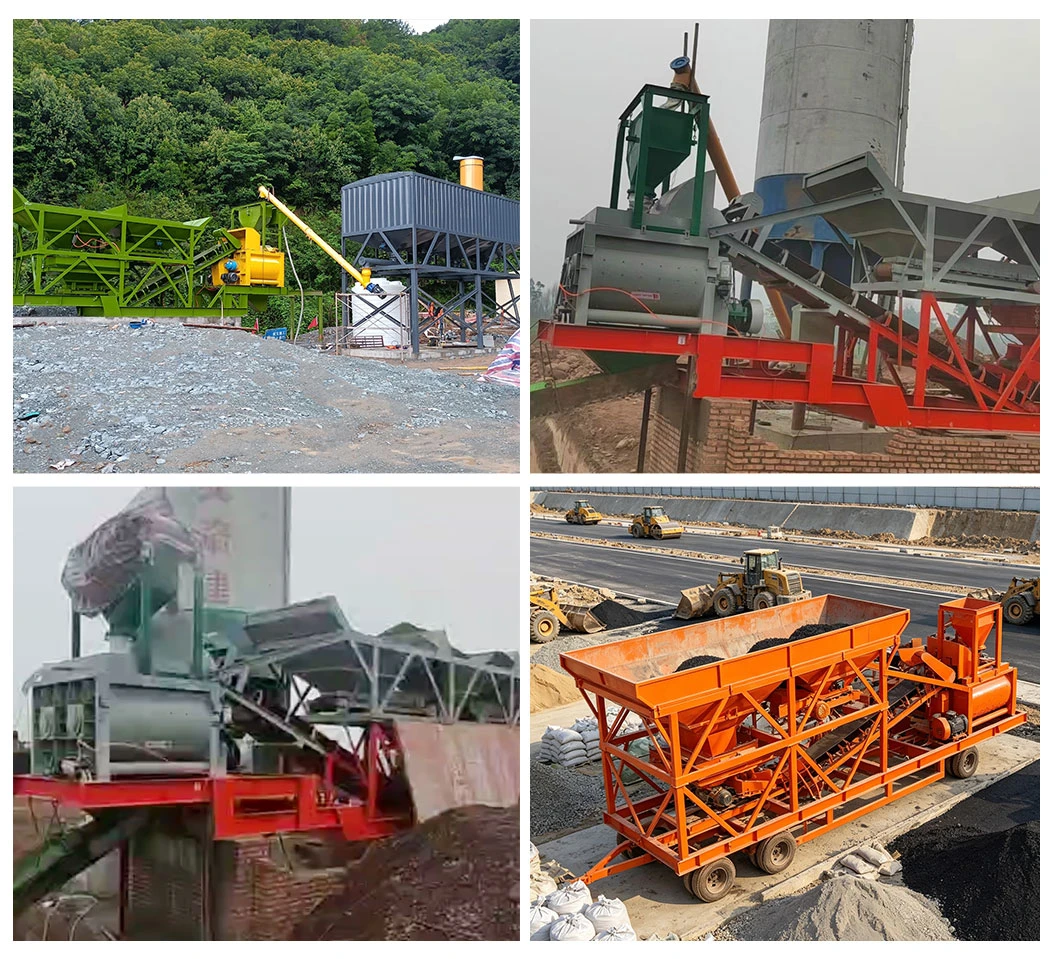
Case 1: Nigeria — Lagos Outer Ring Expressway (2× YHZS75)
Location: Lagos State, Nigeria
Project: 28 km outer ring expressway, 4-lane carriageway with concrete median barrier
Equipment: 2× YHZS75 mobile concrete batching plants operating in parallel
Duration: 14 months
The contractor deployed two YHZS75 units at the project’s midpoint and 12 km mark, eliminating the need for a transit mixer fleet entirely. Each plant was relocated three times as the paving front advanced, with relocation and recommissioning completed in a single 8-hour shift. The JS1500 twin-shaft forced mixers produced C35 pavement concrete at 75 m³/h each, with concrete delivered directly to the slip-form paver via site dumpers — achieving a continuous paving rate of 400 meters per day.
Key Results:
Total concrete produced: 84,000 m³ over 14 months
Eliminated 6 transit mixer trucks (capital savings: $210,000)
Cement weighing accuracy maintained at ±1% throughout — passing all DOT QA/QC testing
Equipment failure rate: <1.5% (downtime <4 days total)
Plant relocation cost: $1,200 per move (×6 total = $7,200)
Estimated savings vs. stationary plant + truck fleet: $340,000
Case 2: Indonesia — Trans-Sulawesi Railway Bridge Project (1× YHZS90)
Location: South Sulawesi, Indonesia
Project: 8-span railway bridge, pier foundations and deck concrete
Equipment: 1× YHZS90 with diesel-electric dual drive + 150 kW Cummins generator
Duration: 11 months
The project site was located 60 km from the nearest grid power connection, making the dual-drive configuration essential. The YHZS90 operated on generator power throughout the project, with the Cummins 6BT5.9 engine consuming approximately 22 L/h of diesel at full load — a fuel cost of $4.50/hour at local prices. The JS2000 twin-shaft mixer produced C40 bridge-grade concrete with fly ash substitution (20% cement replacement), achieving 28-day compressive strength consistently above 42 MPa.
Key Results:
Total concrete produced: 38,000 m³
Concrete strength: 42–48 MPa at 28 days (specification: 40 MPa)
Fly ash substitution: 20% (cement cost savings: $38,000)
Generator fuel cost: $11,000 total (vs. $0 grid cost — but $180,000 grid connection cost avoided)
Equipment setup time: 7 hours from trailer arrival to first batch
Total project concrete cost: 135/m³ purchased ready-mix in Makassar)
Case Study 3: Angola — Provincial Road Rehabilitation (1× YHZS35)
Location: Malanje Province, Angola
Project: 45 km provincial road rehabilitation, concrete base and drainage structures
Equipment: 1× YHZS35 with 3-compartment aggregate batcher
Duration: 8 months
The contractor selected the YHZS35 for its compact footprint (11 m × 2.5 m) and container-shippable weight (22 t), which allowed direct transport from the Port of Luanda to the project site without special haulage permits. The plant was positioned at the base camp and supplied concrete to four separate work zones within a 15 km radius via 3 site dumpers.
The JS750 twin-shaft forced mixer produced C25 road-base concrete at 35 m³/h, with the PLC automatically adjusting water content based on aggregate moisture readings from the optional microwave moisture sensor. The diesel-electric dual-drive system allowed continuous operation during the frequent grid power outages characteristic of rural Angola.
Key Results:
Total concrete produced: 22,000 m³
Average daily production: 140 m³/day (project average)
Power interruptions handled: 47 events, zero concrete lost
Plant relocation: 1 mid-project move (4 hours, completed by 2-person crew)
Operator training: 3 days (1 operator + 2 laborers)
Equipment payback: 5.2 months (material cost savings vs. purchased ready-mix)
Post-project: Equipment redeployed to a second road project in Bié Province
Customization


Dealer Customization Policy
FAQ
Absolutely. We offer comprehensive OEM and ODM services for your branding needs, including custom logos, personalized paint colors, and specific packaging designs.
Just 1 unit to start. We encourage sample testing. For bulk orders or mixed-container shipments, we provide aggressive wholesale tier pricing.
We manage the heavy lifting. All equipment is secured in export-grade wooden crates. We offer Sea, Air, and Train freight options, handle all export documentation, and specialize in mixed-container consolidation to minimize your shipping costs.
Yes. Every machine ships with intuitive operation manuals and video tutorials. For major fleet purchases, we provide dedicated remote video training to ensure your team is ready to go.
Downtime kills profits. You have 24/7 access to our technical troubleshooting team. We also maintain a massive inventory of genuine spare parts ready for immediate air freight.
We balance rugged, commercial-grade quality with direct wholesale pricing. We aren’t selling cheap, disposable machines. You are investing in high-ROI equipment backed by a reliable supply chain and flexible payment terms.